


This article will discuss:
- about the types of dental crowns;
- about the process of installing artificial dental crowns;
- about the service life of such prostheses.
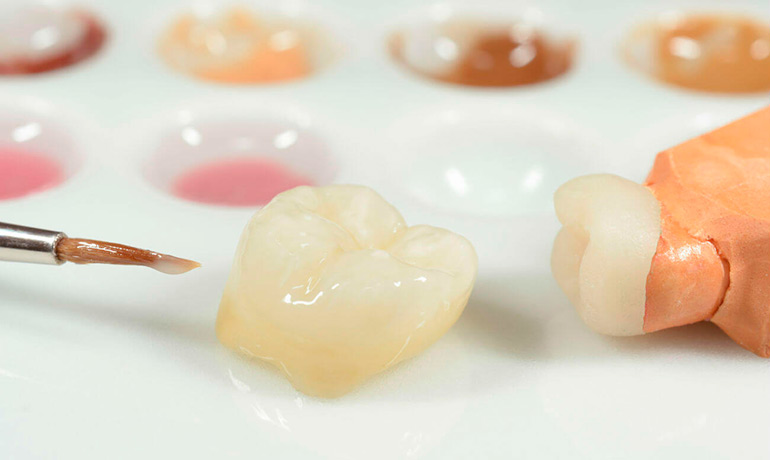
Modern dentistry offers patients a solution to almost any dental problem., and the ability to save, it would seem that, hopeless dental units. Even when there is almost nothing left of the tooth, there is no need to remove it - you can put a crown, under which the tooth will stand for decades. A crown on a tooth is a non-removable prosthesis, designed to replace the visible part of the dental unit. The shape of the crown resembles a cap, which is worn on top of the tooth, protecting him, and performing all the functions of a natural dental unit.

Artificial crowns are made in a dental laboratory by dental technicians, and prostheses are installed by orthopedic dentists. Usually, prosthetics with crowns are addressed in those cases, when the degree of damage to the tissues of the tooth exceeds fifty percent, and the installation of tabs and seals is considered inappropriate. To teeth, who got artificial crowns, not excreted in the oral cavity, enamel and dentin are cut off from them to the thickness of the prosthesis. The latest techniques for manufacturing prostheses allow artificial crowns to be made with such precision., that all their visual characteristics will one hundred percent repeat the characteristics of natural dental tissues. Well-chosen, correctly made and correctly installed dental crowns on the eye from natural teeth can not be distinguished in any way.
The prosthesis of the "crown" type can act as an independent orthopedic structure and be used for the manufacture of bridge-type structures., replacing several missing teeth in a row. Crowns do not have to be worn only on natural teeth - they can be installed on implants, if it is decided to eliminate the defect of a completely missing tooth by implantation.
Indications and contraindications for crown prosthetics
When Do You Need Tooth Restoration?, the dentist is guided by such indications for the installation of crowns:
- The crown region of the tooth is more than half destroyed. This mostly applies to dental units., from which the nerves were removed, followed by root canal filling.
- Tooth enamel wears off. The crown stops the process of tooth abrasion and eliminates the problem of underbite.
- Requires correction of the shape of the tooth, its size or color (due to injury, disease).
- Missing one or more teeth. This defect can be restored by means of implantation or by installing a bridge / clasp prosthesis.
- The patient has major dentoalveolar anomalies. Natural dental crowns are replaced by artificial ones during the elimination of bite pathologies, speech defects, severe misalignment of teeth, that braces can't handle.
Contraindications to the installation of artificial crowns on the teeth experts argue to this day, but most doctors agree, that it will be necessary to refuse prosthetics with crowns in the following cases:
- Low crown height.
- Allergy to crown components.
- Significant mobility of the dental unit.
- Severe malocclusion.
- Thinning of the walls of the tooth.
- Gum disease in the acute stage.
- Patient age up to sixteen years.
If the obstruction to prosthetics can be removed, then the dentist does it, and then sets the crown.
What are the types of dental crowns and which are better?
Depending on the material of manufacture, these types of dental crowns are distinguished.:
- plastic and metal-plastic (for temporary prosthetics);
- metal (from precious and non-precious alloys);
- all-ceramic;
- ceramic on a metal frame;
- ceramic on zirconia frame.
Most often you can find crowns made of metal-ceramic and metal. The spread of metal prostheses is due to the fact, that a few decades ago they were installed in almost all patients for lack of more aesthetic and high-quality analogues. Poorer patients wore non-precious crowns, and richer clients were offered the installation of gold prostheses, what was considered an indicator of the patient's standard of living. And that one, and that metal prosthesis had its drawbacks, the first of which was considered unaesthetic, after all, metallic colors contrasted in a number of natural dental units. To date, all-metal crowns prosthetize distant chewing teeth., if the goal is to save money.
Metal-ceramic artificial crowns meet the requirements of aesthetics, since only the base of the structure is made of metal, and the visible part of the prosthesis consists of a porcelain veneer. Porcelain color is carefully selected, so that the crown matches the colors of the patient's tooth enamel. However, one has to refrain from prosthetics with ceramic-metal smile lines, because metal can be visible under a thin ceramic layer in the light. But in the chewing part of the dentition, metal-ceramic functions as well as possible.
If the patient expects maximum aesthetics from prosthetics, then the best solution would be to install metal-free ceramics. You can't really tell it apart from natural teeth.. And the choice in favor of a ceramic prosthesis on a zirconium frame provides aesthetics, and crown durability. Truth, the cost of such a prosthesis will not seem affordable to every patient.
Metal crowns
Metal dental crowns are:
- One-piece. Prosthesis, made in accordance with this technology, cast according to the exact model. A crown made of cobalt-chromium alloy can be made "under gold", making a spray. The advantages include high strength and wear resistance, as well as a small price. The main disadvantage is the lack of aesthetics.
- stamped. The stamping method is considered obsolete, but many patients at one time wore stamped prostheses. Crowns were stamped from steel sleeves. Steel could be given a golden look by sputtering. Such crowns did not require strong grinding of teeth and a lot of money - these are pluses. And from the minuses distinguish unaesthetic, fineness of metal, reducing the life of the crown, low accuracy of prosthesis manufacturing (crowns, poorly grasping the tooth neck, do not protect dental tissue from saliva, fragments of food and reproduction of microbes).
- Golden. Precious crowns are out of fashion, and today they can only be installed in state dentistry, since special permission is required for prosthetics with gold metals. These dentures are expensive., soft and unaesthetic, that's why they're not in high demand., although their hypoallergenicity can be envied.
Metal-ceramic crowns
In modern dentistry, ceramic-metal is the most popular, as it combines optimal durability indicators, strength, aesthetics and value. The framework of the prosthesis may consist of alloys of precious or non-precious metals., and its thickness varies from 0,3 to 0,5 millimeters. Porcelain mass is applied to the frame in layers, fixing each layer by high temperature treatment in a special oven. Under the influence of incredibly high temperatures (800-950 degrees) metal and ceramics are firmly bonded to each other, and porcelain acquires special strength.
The metalwork looks great, she is hygienic, durable and functional. The color of the prosthesis does not change over time. But this type of prosthetics has its weaknesses.. Not considering their aesthetic gap on the front teeth, the disadvantages of cermets include the need for strong grinding of teeth under the crown (tooth is losing 1,5-2 millimeters of fabric on each side) and the need for depulpation of prosthetic dental units (in most situations). If an already depulped tooth is being prosthetized, the degree of processing does not matter, but the patient does not always want to depulp live teeth.
Metal-free ceramics
The absence of metal in prostheses provides additional aesthetics of crowns. Distinguish:
- Porcelain crowns. This material fully matches the colors and translucency of natural teeth., since its physico-optical properties and structure are similar to those of tooth enamel. Among the advantages of all-ceramic prostheses, their aesthetics are distinguished., biocompatibility, hygiene, ease. The color of ceramics remains unchanged throughout the entire period of operation, and under such prostheses, the teeth are grinded less, than under cermet. Among the shortcomings of ceramics, its high cost and the impossibility of manufacturing long prostheses from ordinary porcelain are noted..
- Zirconia crowns. Ceramics, reinforced with zirconia framework, the most aesthetic and durable. Such prostheses are made using the latest technologies and materials., therefore they perfectly match the characteristics of the patient's teeth. They are used in any places of the dentition to eliminate a wide variety of defects.. Zirconia crowns are comfortable and safe to wear, and their service life may exceed twenty years. The disadvantage of zirconium is one - a high price.
Plastic crowns
Plastic is not suitable for long-term wear - it is installed for a short period of time (often as part of implantation). Among the advantages of plastic prostheses, one can single out the speed of manufacture, initial aesthetics and low cost. Disadvantages look like this:
- plastic is fragile, and the crown wears out quickly;
- acrylic is part of the prosthesis, often allergic;
- the porosity of the plastic promotes the growth of bacteria in the oral cavity;
- plastic is prone to staining with food coloring, and does not retain its presentation for a long time;
- the crown often injures the mucous membranes, causing inflammation.
Metal-plastic crowns
This is a combined type of prosthesis: one-piece cast frame is made of cobalt-chrome alloy, and the front surface of the crown is lined with white plastic.
These crowns are inexpensive and look good., but don't last long, because:
- over time, dentures will change color and start to smell bad, when does the plastic wear off?, metal will “reward” teeth with blue tints;
- crowns will not withstand strong chewing load;
- metal-plastic emits harmful substances, dangerous for allergy sufferers.
The negative aspects of metal-plastic prosthetics also include the need for strong grinding of teeth.. Such a crown can last no more than five years..
Crowns for implantation
Installation of implants in place of lost teeth is beneficial, but not cheap pleasure. First, artificial tooth roots are screwed into the patient's jaw., and then crowns are put on them. It is convenient and aesthetic, and from a functional point of view, because the installation of dental crowns on the implant eliminates the need for processing under the bridge prosthesis adjacent to the defect of the teeth, which reduces the risk of complications after prosthetics. The crown is fixed on the implant using an adapter (abutment), which is screwed into a titanium root. This method can restore any number of teeth.. Usually, prostheses made of ceramics or ceramic-metal are placed on implants.
To fix the crowns on artificial roots, a screw or cement is used.. Screw fixation involves the connection of the crown and adapter outside the oral cavity, then this design is attached to the implant with a screw. After installing the crown, the hole is masked with a composite material.. During cement fixation, the adapter is first screwed to the implant with a screw, then the crown is bonded to the abutment using a special composite compound.
How artificial crowns are installed?
Before, How will a crown be placed on a tooth?, the dental unit is prepared for this procedure. It happens like this:
- The dentist conducts a visual examination of the tooth and sends the patient for an x-ray. If necessary, the tooth is treated, depulped, filling his root canals.
- The patient is given local anesthesia, and the tooth is prepared taking into account the thickness of the future prosthesis. As a result, the walls of the turned dental unit converge upwards, so that the crown is easy to put on, ledges are made in the cervical region of the tooth.
- If the upper part of the dental unit is missing, the doctor installs a metal stump tab, so that the prosthesis can be securely fixed on the tooth.
- If the anatomical crown of the tooth is destroyed, a pin is placed in the root of the tooth.
- An impression of the teeth is made, which is sent to the laboratory.
- The patient is given a temporary crown., she wears until then, until the permanent.
- When the dental technician will make the crown, she goes back to the dentist, where the patient is trying on and installing a prosthesis.
How crowns are made?
When the dental units are fully prepared for prosthetics, casts are taken from the jaws, thanks to which crowns can be made with maximum accuracy, taking into account the size and location of the dental units adjacent to the defect and antagonist teeth. Casts are made from a special impression mass. In a dental laboratory, a dental technician models a sample of a future prosthesis using a cast. After its frame is formed, which is covered with cladding material. At the end, the dental technician gives the desired color to the prosthesis.
Dental crowns made of the latest materials are made on high-tech equipment using computer technology, and this process is fully automated.
Service life of artificial crowns
Any prostheses, placed in the oral cavity, sooner or later to be replaced. How soon will you have to repeat the prosthetic procedure, depends on the material, from which the crown was made, quality of the prosthesis and oral hygiene. Average, metal prostheses last ten years, cermet - from ten to twelve years, zirconium - more than twenty. All-ceramic dentures were previously considered short-lived, but ceramics made using new techniques can stand for fifteen years.
In most cases, patients have to remove crowns before, how do they fall into disrepair. Often, due to improper preparation of teeth for prosthetics under the crown, problems arise. The patient must discover this before, How does the prosthesis warranty expire? (usually, warranty period - one and a half years), to save money on re-prosthetics. You can check the condition of the dental unit under the crown, taking an x-ray.
Price for dental crowns
How much does a crown cost for a tooth? The answer to this question will depend on several factors.:
- Status of the dental institution. Each dentistry adheres to its pricing policy and focuses on patients with certain incomes..
- Personnel qualifications. The success of prosthetics in the hands of a prosthodontist and dental technician. The professionalism of specialists is well paid.
- Cost of consumables. Crowns made of imported materials are more expensive than domestic ones.. Usually, their quality is also higher.
If you need a dental crown, price will be about:
- single German ceramic-metal crown – from 1200 hryvnia;
- metal-free ceramics E-MAX – from 4000 hryvnia;
- crown on a zirconium frame 4000 hryvnia.
Dental crowns in Kharkov
If you want to install high-quality artificial crowns, then we invite you to order a prosthesis in the dental laboratory "City Dental". For more than seventeen years, our team of highly qualified dental technicians has been manufacturing dentures of any complexity.. The laboratory is equipped with the latest technology. We work with the latest imported materials, and guarantee, that our prostheses will be worn aesthetically for many years.
We have extensive experience in remote work, because City Dental is trusted not only in Ukraine, but also in other CIS countries, as well as in Europe.
No matter how expensive and large-scale the upcoming prosthetics may seem to you, ordering dental crowns in our laboratory will make your dental treatment more comfortable and of high quality.